Evolving Legal Landscapes Impacting Bingo Platform Modifications and International Prize Pool Participation
Noah Vogel · Aug 3, 2026

Evolving Legal Landscapes Impacting Bingo Platform Modifications and International Prize Pool Participation
Regional regulations continue to drive significant modifications in bingo software development cycles while simultaneously restricting how operators pool and distribute cross-border jackpots across multiple jurisdictions. Data from industry reports shows that compliance requirements in areas such as data protection, age verification systems, and responsible gaming tools force developers to release frequent patches and localized versions of their platforms throughout 2025 and into 2026.
Developers often integrate new modules for geolocation checks and currency conversion protocols because authorities in separate markets demand these features before approving software releases. Research indicates that such adjustments extend update timelines by several months compared to regions with fewer restrictions, and this pattern holds steady across North American and Asian markets alike.
Software Update Cycles Under Regulatory Pressure
Observers note that Canadian provincial frameworks require bingo operators to embed real-time transaction monitoring into their systems before any major software rollout occurs, and this mandate compels teams to rewrite core code sections for each province rather than deploying a single unified update. Figures from the Canadian Gaming Association reveal that operators spent an average of 14 weeks on compliance testing alone during the first half of 2025, delaying features like enhanced mobile interfaces that could otherwise launch simultaneously worldwide.
Meanwhile, Australian state-level rules push for separate jackpot pools within individual territories, which means developers must segment server architecture to prevent unauthorized cross-state prize accumulation. Those who study these patterns observe that the resulting code branches increase maintenance costs while reducing the frequency of global feature releases.
Cross-Border Jackpot Limitations and Technical Workarounds
Legal barriers in the European Union and parts of Asia further complicate jackpot accessibility because operators cannot freely merge player contributions from different countries without violating local gaming statutes. A report issued by the European Gaming and Betting Association details how staggered tax reporting standards across member states force platforms to isolate jackpot ledgers by region, limiting the size of progressive prizes available to participants.
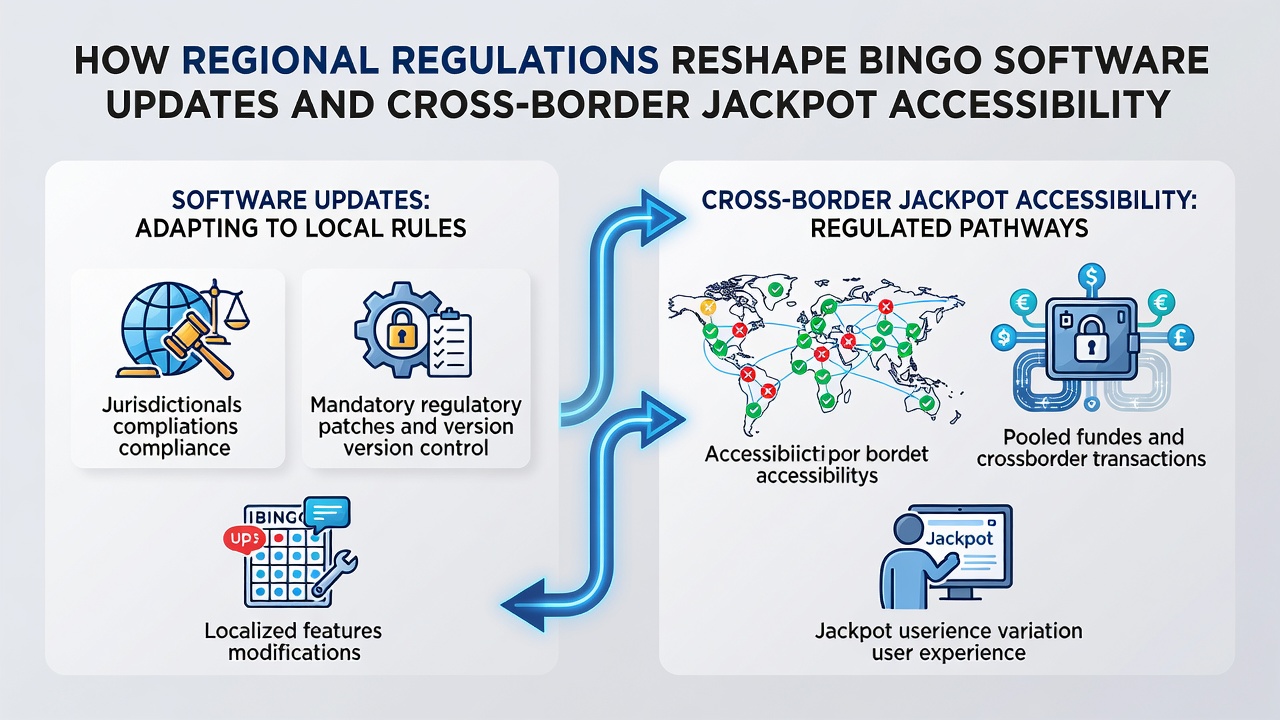
Yet many companies respond by building modular jackpot engines that activate or deactivate based on player location, allowing continued operation without full cross-border pooling. Data collected through 2025 demonstrates that these segmented systems maintain prize growth within compliant boundaries while still providing substantial rewards to users in permitted areas.
August 2026 marks the scheduled implementation of updated digital gaming standards in several Australian jurisdictions, which will require additional verification layers for any jackpot that spans multiple states. Industry analysts expect these changes to prompt another round of software revisions focused on audit trails and automated tax deductions at the point of prize allocation.
Regional Examples of Compliance-Driven Changes
Take the case of operators serving both Canadian and European markets, where differing privacy regulations necessitate distinct data handling routines within the same bingo application. Programmers often maintain parallel code repositories so that one version meets strict European data residency rules while another satisfies Canadian provincial reporting needs, and this dual-track approach has become standard practice according to recent sector surveys.
Similar dynamics appear in Asian markets where certain governments prohibit foreign jackpot contributions entirely, prompting developers to create standalone prize structures that mirror international pools in appearance but operate independently. Research from academic studies on gaming technology shows these adaptations preserve player engagement levels even when full cross-border access remains unavailable.
Future Adjustments and Industry Responses
Companies continue to invest in flexible backend systems that can accommodate new rules with minimal disruption, and evidence suggests this strategy reduces the time between regulatory announcements and compliant software deployments. Regulatory bodies in multiple regions publish updated guidelines on a rolling basis, which keeps development teams engaged in ongoing testing and certification processes throughout each calendar year.
Those tracking these trends note that collaboration between software providers and legal experts has grown more common as firms seek to anticipate upcoming changes rather than react after the fact. This proactive stance helps maintain service continuity for players while satisfying the varied demands of different licensing authorities.
Conclusion
Regional regulations shape bingo software evolution and jackpot distribution through layered compliance demands that differ sharply by jurisdiction, leading developers to adopt segmented architectures and frequent localized updates. Data from multiple sources confirms these patterns will persist into late 2026 as new standards take effect in key markets, requiring continued technical innovation to balance regulatory adherence with operational efficiency.